
Retail inflation breached the RBI's comfort zone and rose to a three-month high of 6.52 per cent in January, mainly on account of a spike in food prices, as per government data released on Monday. The inflation rate based on the Consumer Price Index (CPI) stood at 5.72 per cent December and 6.01 per cent in January 2022.

The RBI added roughly 3 tonnes in 2025, taking its gold reserves to 879 tonnes as of January 31, 2025.

For the consumer, there would be practically no impact on prices of essential medicines this year.

Renewed inflationary pressures, led by a spike in prices of vegetables and cereals, have cast a spell on the equity markets in the past month. The BSE Sensex and Nifty50 have declined up to 2 per cent each during the period, clipping the 13 per cent rally from the March lows, shows data from ACE Equity. Investors typically consider shares of fast-moving consumer goods (FMCG) companies as defensive bets, putting their weight behind them in a falling market.

Stock markets will be driven by further developments on the US-China tariff war front along with quarterly earnings announcements from IT majors Wipro and Infosys in a holiday-shortened week, analysts said. Global market trends and trading activity of foreign investors would also dictate market movement this week, experts noted.

While SGBs are a sound investment, they aren't worth buying at any price. The interest income you earn from them will not justify paying a high premium.

Quarterly earnings of corporates, trading activity of foreign investors and inflation data are the key factors that are expected to drive the momentum in the equity markets this week, analysts said.
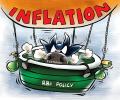
The Reserve Bank on Wednesday projected inflation to come down below the upper threshold level of 6 per cent by March quarter of the current fiscal. RBI Governor Shaktikanta Das said the central bank will keep 'Arjuna's eye' (focus) on the evolving inflation dynamics and will remain 'nimble and flexible' to deal with the price situation. Global commodity prices, including crude oil, have undergone some downward correction, but uncertainty continues to surround the near-term outlook in view of the prolonging geo-political hostilities. Moreover, the resurgence in domestic services sector activity could also lead to price increases, especially as firms pass on input costs.

India's prices are rising faster than many of its emerging market peers. The country's inflation print for May at 4.25 per cent is a marked reduction from the levels seen in May 2022 (7.04 per cent). However, even though the inflation rate remains within the Reserve Bank of India's medium-term target of 4 per cent, with a 2 per cent margin on either side, it continues to be higher than China, Russia, and Brazil.

'There is no linkage as far as the Indian power-generating business is concerned.'

The US Fed interest rate decision, global trends, tariff-related developments and trading activity of foreign investors will drive the equity market movement this week, analysts said. Among macroeconomic data announcement, WPI inflation for February is scheduled to be announced on Monday.

Preparing a 'vegetarian thali' got dearer by 34 per cent in July as compared to June because of the soaring tomato prices, an arm of a rating agency said in a report on Monday. A non-vegetarian thali was relatively less impacted and the price of preparing one went up by only 13 per cent, Crisil's 'Roti Rice Rate' report for August said. The inflation in the thalis is largely driven by the 233 per cent jump in tomato prices to Rs 110 per kilogramme in July from Rs 33 in June, the report said.

'April 9 announcement of slapping a 125% tariff on Chinese goods has brought the focus back to China, making this new phase feel like a repeat of the original conflict.'

'Challenge is basically near-term growth as the outlook has turned a bit adverse.'

United States President Donald Trump on Sunday warned of new and significantly higher tariffs on Chinese goods if Beijing does not withdraw a recent 34 per cent retaliatory tariff hike, threatening to end all ongoing talks with China.

If you redeem your investments when prices have fallen sharply, you will be selling at low prices and may make a permanent loss. On the other hand, if you remain patient and remain invested, you give your investment the time to recover, says Dwaipayan Bose

Revive growth by taxing fuels less and lowering interest for productive loans.

Wouldn't it be better to reach 45 with a backup engine of passive income that helps you glide through these years instead of grinding, asks Ramalingam Kalirajan

From the 30-share blue-chip pack, Mahindra & Mahindra, Zomato, Tata Motors, IndusInd Bank, Reliance Industries, Larsen & Toubro, UltraTech Cement, HDFC Bank, Adani Ports and Bajaj Finserv were among the major laggards. On the other hand, Hindustan Unilever, Tech Mahindra, Nestle, Bharti Airtel and ICICI Bank were among the gainers.

Higher inflation has again become a matter of concern for fast-moving consumer goods (FMCG) companies. After prices of commodities like sugar and wheat moved higher and stabilised at those levels, the crude oil too surged, adding to FMCG firms' worries. Besides, a dry spell in August in the ongoing monsoon season impacted rural demand.

While headline and core WPI are stuck in a disinflationary phase, the retail measure is inching north.

Crorepatis build wealth through disciplined saving, smart investing, and strategic risk-taking, proving that true financial freedom is earned, not inherited, says Ramalingam Kalirajan

The last time this happened was in 1996.

Usually, turmeric is grown over 290,000-330,000 hectares of land. But in 2022-2023, according to official estimates, there has been a drop of about 10,000 hectares.

From the Sensex pack, IndusInd Bank, Infosys, Bajaj Finserv, Mahindra & Mahindra, Zomato, Hindustan Unilever, Power Grid, Axis Bank, UltraTech Cement, Adani Ports, and Tata Consultancy Services were among the laggards. On the other hand, Sun Pharmaceuticals, ICICI Bank, Bharti Airtel, HCL Technologies, Maruti Suzuki India, Larsen & Toubro, Reliance Industries, Kotak Mahindra Bank and Titan were the gainers.

Nationalist Congress Party leader and Maharashtra Deputy Chief Minister Ajit Pawar on Saturday didn't join his cabinet colleagues Devendra Fadnavis and Chief Minister Eknath Shinde in visiting the Nagpur-based memorial of the Rashtriya Swayamsevak Sangh founder.
With concern on food inflation ebbing with the monsoon progressing well, the Reserve Bank of India (RBI) is warming up to the idea of a change in stance to "neutral" from "withdrawal of accommodation", according to economists. In his speech on Thursday during the annual event of the Federation of Indian Chambers of Commerce and Industry-Indian Banks' Association, RBI Governor Shaktikanta Das said: "The balance between inflation and growth is well-poised."

'2025 is the year to build a portfolio for the future. Focus this year should be on valuations and visible growth.'

Gold prices hit a fresh record high of Rs 84,900 per 10 grams in the national capital on Friday, driven by robust domestic demand and strong global cues, according to the All India Sarafa Association. The precious metal of 99.9 per cent purity continued its ascent for the third straight session, jumping by Rs 1,100 to hit a new peak of Rs 84,900 per 10 grams.
Retail inflation declined to an 18-month low of 4.7 per cent in April mainly due to falling prices of vegetables, oils and fats, and came closer to Reserve Bank's target of 4 per cent, showed government data released Friday. It was for the second month in a row that Consumer Price Index (CPI) based inflation remained within the RBI's comfort zone of below 6 per cent. The government has tasked the central bank to ensure retail inflation remains at 4 per cent with a margin of 2 per cent on either side.

The government on Monday ruled out making public the RBI report detailing the reasons why the central bank could not keep inflation within the targeted 6 per cent upper limit for the three consecutive quarters. "Yes sir, RBI has furnished a report to the central government, as mandated under Section 45ZN of the RBI Act, 1934 and Regulation 7 of RBI Monetary Policy Committee and Monetary Policy process Regulations, 2016," minister of state for finance Pankaj Chaudhary said in a written reply. The said provisions of the RBI Act, 1934, and regulations therein does not provide for making the report public, he said.

The risk-reward for the Indian markets, Morgan Stanley said, is turning favourable.

The weaker rupee will push the country's import bill due to higher payments for crude oil, coal, vegetable oil, gold, diamonds, electronics, machinery, plastics, and chemicals, economic think tank GTRI said on Friday. Citing an example, it said the depreciating domestic currency will increase India's gold import bill, especially as global gold prices have jumped 31.25 per cent, rising from $65,877 per kg in January 2024 to $86,464 per kg in January 2025.

For those looking for more affordable options, purchasing an under-construction property could be a smart move, as these generally cost less than ready-to-move-in properties.

'And America will invite India in to have really an extraordinary opportunity and relationship with us.'

62 per cent of respondents across various demographics, including villages, towns, and cities, perceived a greater difficulty in securing employment compared to the previous five years, shows pre-poll survey by Centre for Study of Developing Societies.

'The RBI's MPC will maintain the current policy rates (6.50%) at the policy meeting, given ongoing inflationary pressures.'

Sounding a note of caution, the Reserve Bank said on Friday said there is a risk of high wholesale price inflation (WPI) putting pressure on the retail inflation, albeit with a lag. In its annual report, the RBI said that the cost-push pressures from high industrial raw material prices, transportation costs and global logistics, and supply chain bottlenecks continue to impinge on core inflation. "The substantial wedge between wholesale and retail price inflation amidst a sharp rise in manufactured products' inflation poses the risk of a possible passthrough of input cost pressures to retail inflation with a lag, although slack in the economy is muting the pass-through," the central bank noted.

'A possible post-election growth momentum may be lost.'

A fall in prices of some oil products nudged India's wholesale price inflation lower in the week ended April 5, and analysts said they expected a further easing of prices as the war in Iraq comes to an end.
